

.png?width=688&height=487&name=image001%20(1).png)
Industry
Technology
Challenge
$260 billion. That's how much e-commerce loses every year to abandoned carts. And a massive chunk of that isn't price sensitivity or weak intent. It's shoppers who wanted to buy, got to the page, couldn't find the answer they needed, and left. That answer? Your Preezie assistant probably fielded it the very same day.
Opportunity
Here's the opportunity most brands are sleeping on. Preezie isn't just resolving queries. It's building a real-time map of every confidence gap on every product page in your store. Brands already using it this way are hitting 85% to 110% conversion rate increases and 20x ROI. This is how they do it.
GEO SEO CRO
AI shopping assistant
"Your Preezie chat logs aren’t just support data. They’re a live feed of the questions standing between shoppers and conversion."


About Alley Group
Alley Group is an independent Australian digital marketing agency specialising in strategy, acquisition, data, and design. Known for its performance-driven approach, Alley helps brands grow through services including SEO, GEO, SEM, CRO, web development, analytics, and data strategy.
Why Shoppers Leave Even When They Want to Buy
There's a concept in customer experience called Information Symmetry. Simply put, a purchase happens when the shopper knows everything they need to know. The moment that balance tips, and the page holds back something the shopper needs, the sale is at risk.
This connects directly to Customer Effort Score, a measure of how hard a customer has to work to get what they need. High effort equals low conversion. Every time a shopper has to hunt for information, open a chat window, or ask a question, the effort score climbs. And with it, so does the chance they walk away.
Your Preezie chat data tells you exactly where Information Symmetry is breaking down. Every repeated question is a page failing the effort test. Fix those gaps, and you don't just improve the chat experience. You fix the page itself.
What Your Preezie Queries Are Actually Telling You
Let's make this concrete.
A skincare brand sees Preezie fielding the same question hundreds of times a week: "Is this safe for sensitive skin?" The product page lists ingredients. It does not speak to skin type. That’s information asymmetry. High customer effort. Lost conversions.
An electronics retailer sees "Will this work with my existing setup?" coming through constantly on a home audio product. The page covers specs. It says nothing about compatibility with common systems. Same problem. Different category. Same result.
These are not edge case queries. They are purchase-critical questions your pages are failing to answer. And Preezie is capturing every single one of them.
The pattern across thousands of sessions is not noise. It's a precise, prioritised list of exactly where your pages are leaking revenue.
How to Turn That Data Into Higher-Converting Pages
Here's the exact process. No six-week consultant timeline. No five-figure research budget. Just your Preezie data, used properly.
Step 1: Pull your top queries. Export the 20 most frequently asked questions from the last 90 days. Group them into themes. You now have a ready-made gap analysis of your highest-traffic product pages. Done in an afternoon.
Step 2: Score by volume and page. Match each question cluster to the product pages they relate to. The pages generating the most questions are your biggest CRO opportunities. Start there.
Step 3: Identify the information gap behind the question. Don't just answer the question on the page. Dig into what it represents. "Is this safe for sensitive skin?" is not an ingredients question. It's a trust question. "Will this work with my setup?" is not a specs question. It's a compatibility anxiety question. Address the underlying concern, and you remove the barrier completely.
Step 4: Rewrite the page in your customer's language. Use the exact phrases your shoppers typed into Preezie. Not marketing language. Not product spec language. The real words real people used when they were one answer away from buying.
Step 5: Measure and repeat. Once the page is updated, continue the process and optimize other pages and areas of the site. Track and measure conversions and performance.
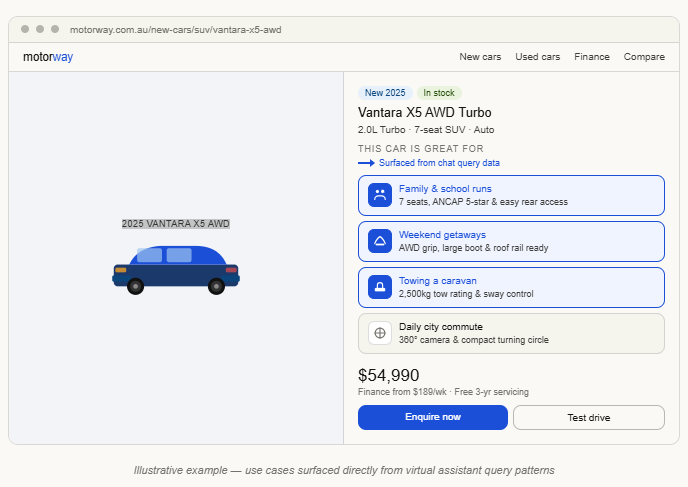
How This Worked in Practice
In one recent project, Alley Group used anonymised Preezie chat data to identify the questions shoppers were repeatedly asking and turn those insights into practical CRO recommendations. Rather than treating chat logs as support data alone, the queries were grouped into themes to uncover where product pages were missing key information, creating unnecessary friction in the buying journey.
The result was a clearer view of which customer concerns mattered most and where on-site content could do a better job of answering them upfront. It’s a simple example of how conversational data can be used to inform smarter product page improvements, stronger UX, and better conversion outcomes.
Your Data Is Ready. Are You?
Every session. Every query. Every repeated question. Preezie has been collecting the most valuable CRO research your business produces, in real time, for free.
The brands hitting 20x ROI aren't doing more research. They're using the research they already have. Start with your top 20 queries this week. The revenue is already in the data.